
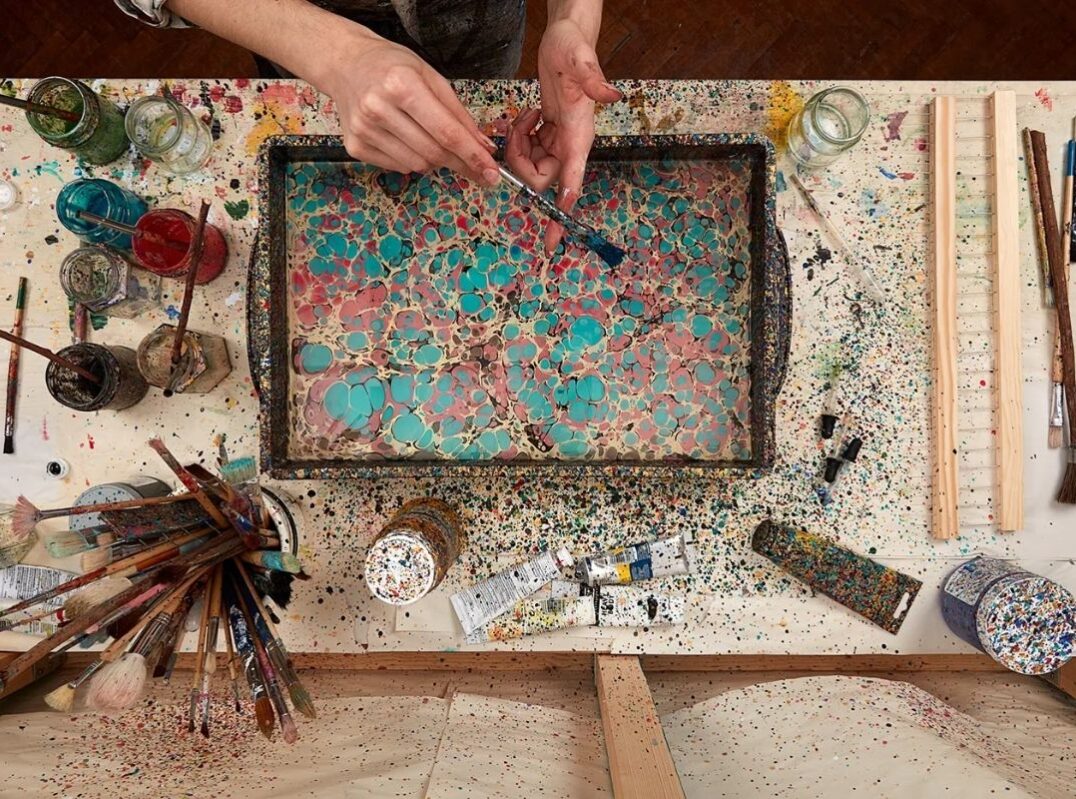
What are the Materials Required for Marbling Art?
Kerajin
Kerajin refers to dried and powdered carrageenan, a type of red seaweed. It is used in marbling art to thicken the consistency of the water.
Preparing the Marbling Water: Add 2 tablespoons of kerajin into 5 liters of warm, lime-free, and rested water and mix well with a blender.
Make sure the kerajin dissolves completely. For better results, it is recommended to let the prepared marbling water sit for 1-2 days before use.
Paints
The paints used in traditional marbling art are natural pigment paints that do not contain oil and are insoluble in water.
Preparing the Paint: Today, there are ready-to-use paints suitable for traditional Ebru making. These paints, sold in jars, are prepared for marbling by adjusting the water and ox-gall levels.
Marbling Brushes
Traditional Marbling Brush
The traditional marbling brush is handmade using completely natural materials. The handle of the brush is made of rosewood, while the tip is made of horsehair.
Materials Used in the Brush:
- Horsehair: Preferred because of its high paint retention capacity. This allows the paint to be distributed sufficiently and evenly into the tank.
- Rose branch: It is an ideal material for the brush handle due to its flexible structure and the fact that it does not easily mold.
Handmade Brush Making:
Take as much horsehair as you need depending on the size of our brush. Initially, it is held together with a rubber band to prevent the hairs from scattering. Then, the rose branch is placed in the middle of the horsehair, and it is tightly wrapped and tied with nylon thread to prevent the hairs from scattering. Nylon thread is preferred because it is water-resistant. In the final stage, the hairs at the tip of the brush are cut in line with the help of scissors, and the handmade brush is completed.
Types of Brushes According to Their Purpose of Use:
- Paint mixing brushes: Short-handled and contain a small amount of horsehair.
- Ground and battal brushes: Thick and long-handled.
- Paint brushes: Prepared in medium thickness.
Marbling Tank
The container in which the water prepared for marbling is placed is called a tank. The tank can be made of any material that can hold water. However, the edges should be straight to allow the water to drain when removing the paper from the tank.
Tanks of different sizes can be preferred according to the intended use.
Paper
In marbling making, matte papers with absorbent properties are used. The absorbency of the paper should be neither too much nor too little.
- Very thin papers may tear when removed from the tank.
- Thick papers, on the other hand, may cause air to remain between the water surface and the paper when placed in the tank.
Therefore, it is important to choose paper of appropriate thickness and absorbency for marbling art.
Ox-gall (Öd)
Ox-gall is a natural substance that allows the paint to stay on the water and prevents the colors from mixing with each other. Obtained from cattle, ox-gall does not contain any chemicals or toxic substances. The acids it contains cause a chemical reaction in the paint, giving it a velvety effect.
Use of Ox-gall: Ox-gall is added to the paint with the help of a dropper. Adding it to the paint little by little and testing it on the edge of the tank is important for a successful result. Since ox-gall is a natural substance, it spoils and loses its effect when stored for a long time. For this reason, it should be stored in the refrigerator in hot weather.
When adjusting the ox-gall levels of the paints, the order of the colors is taken into account. A small amount of ox-gall is dripped into the bottom color. For the top layers, more ox-gall is mixed in each time. The more ox-gall there is, the more it pushes the surrounding colors and makes room.
Auxiliary Materials Used in Marbling Making
- Awl (Biz): Metal rods of varying thicknesses used to place and shape paint drops when making Hatip marbling and floral marbling while making paint adjustments.
- Spatula: Used to mix the material in the tank.
- Ox-gall dropper: A dropper is used to add measured ox-gall to paints.
- Drinking trough: We use a pipetted drinking trough when making paint adjustments.
- Jar: Medium and small glass jars are used to store and use the prepared paints.
- Comb: Shaping tools used in comb Ebru making, formed by nailing needles to wooden battens. The pattern is formed according to the frequency of the needles.
- Paper towel: It is used to clean the awl, especially in floral marbling and Hatip marbling making. It must be of a type that does not leave dust.